
AI Is Reshaping Jobs. Here’s How Indian Education Can Lead the Shift.
March 7, 2026
When Government Schools Teach AI, What Is a Private School’s Edge?
October 7, 2026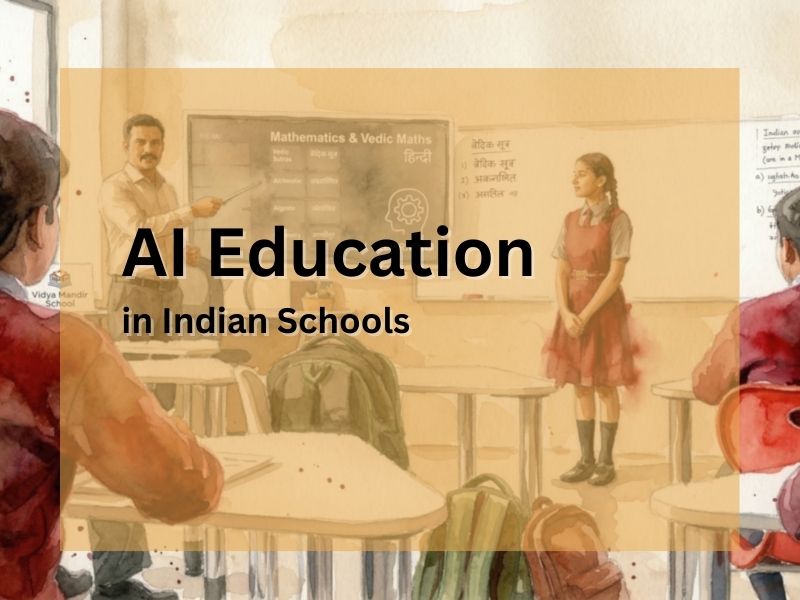
AI Education in Indian Schools: The Window Is Open — But Not Forever
India’s CBSE has mandated AI as a cross-curricular strand from 2026–27. Government grants are available. The world’s best curriculum resources are free. Here is everything a school needs to know.
The schools that build genuine AI education programmes in 2026 will not just be compliant with the upcoming CBSE mandate — they will be a full generation ahead of the schools that wait.
Artificial Intelligence is no longer a subject for university lecture halls or corporate boardrooms. It is arriving in classrooms across India, and forward-thinking schools have a narrow but extraordinary window to lead this transformation rather than follow it.
At AEV Education Network, we have spent the past several months mapping the policy landscape, the global frameworks, and the free resources available to Indian schools. What we found is more accessible — and more urgent — than most school leaders realise.
What Policy Now Requires
The policy direction is unambiguous. CBSE has introduced AI as a formal subject at the secondary level (Subject 417 for Classes 9–10, Subject 843 for Classes 11–12) and has directed schools to embed AI literacy as a cross-curricular strand from Classes 1–12 from the 2026–27 academic year. The 2026–27 Union Budget accelerated this further with a major expansion of Atal Tinkering Labs and a directive to integrate AI across the curriculum.
| CBSE Requirement | Detail |
|---|---|
| Subject 417 | AI elective for Classes 9–10. Covers ML basics, data literacy, AI project work, and societal ethics. Recommended for all students, not just the CS track. |
| Subject 843 | AI elective for Classes 11–12. Advanced AI, Python, neural networks, and a capstone project. |
| 15-Hour AI Module | Mandatory for Classes 6–8 from 2026–27. Embedded in existing subjects, not as a separate class. |
| Cross-Curricular AI | AI literacy integrated across all subjects, all grade levels, from Class 1. |
Schools that have already begun implementing AI education are significantly ahead of compliance requirements. This is a leadership differentiator that is becoming harder to claim with each passing year.
The Global Frameworks: Why International Alignment Matters
India’s CBSE requirements define the floor. But the schools that will genuinely stand out — for parent confidence, institutional rankings, and grant credibility — are those that align to international frameworks as well.
Three frameworks are particularly significant for Indian schools right now:
| Framework | Organisation | Why It Matters |
|---|---|---|
| AI Competency Framework for Students | UNESCO (2022) | The UN’s 12-competency standard for student AI literacy. Directly aligned with CBSE Subject 417/843. Free to download and map. |
| AI Literacy Framework | OECD–European Commission (2025) | 22 competencies across 4 domains. Being adopted rapidly across Europe and Asia-Pacific. The most current international thinking. |
| ISTE Standards | ISTE (2024, v4.02) | Adopted across all US states. Frames AI competency as a core student standard, not just a CS skill. |
A school that maps its AI curriculum to all three international frameworks — alongside CBSE requirements — is globally benchmarked, India-compliant, and has a positioning that no competitor currently offers. Our handbook provides the complete mapping guide.
Building the Curriculum: Grade by Grade
AI education is not a single subject. It is a school-wide capability that needs to be built deliberately across every grade band, each with its own learning goals, tools, and outcomes.
Recognise AI in daily life. Understand that computers learn from patterns. First hands-on activities with Teachable Machine and MIT Day of AI unplugged exercises.
Data literacy, ML concepts, AI ethics. CBSE 15-Hour Module. Students build text classifiers and explore where and why AI fails.
Full AI curriculum with real project work. Societal impact analysis. End-of-year portfolio with design, data, model, and ethical reflection sections.
Advanced AI, Python, neural networks. Capstone project presented to an external panel. Career-ready skills aligned to the fastest-growing roles in India.
What Schools Often Miss
After reviewing how Indian schools are currently approaching AI education, we have found three areas that are consistently underserved — and which determine whether a programme is genuinely effective or merely compliant.
1. Student Assessment
Most schools can tell you what they are teaching. Very few can tell you whether students are actually learning it. A clear rubric — even a simple four-level scale from Beginning to Advanced — transforms AI education from a curriculum checkbox into a measurable outcome.
2. A School AI Policy
Students are already using ChatGPT, Gemini, and other generative AI tools — with or without school guidance. A school that says “no AI” is making an unenforced, unenforceable rule. A school that says “here is how to use AI responsibly, and here is how to disclose it” is both realistic and genuinely educational. The TeachAI Toolkit (backed by Code.org, ISTE, Khan Academy, and the WEF) provides free policy templates.
3. Parent Communication
The most common questions from parents — “Will AI replace my child’s job?” “Is my child’s data safe?” “Is this just more screen time?” — are entirely answerable. Schools that have clear, warm, confident answers to these questions find parent support for their AI programmes dramatically easier to build.
AI literacy does not narrow a student’s career options — it expands them across every sector. The 10 fastest-growing roles in India through 2030 all require meaningful AI competency, including roles in healthcare, law, education, finance, and design — not only technology.
The Free Resources: What Is Available Right Now
One of the most important things to understand about AI education is that the world’s best resources are free. There is no need to wait for a budget cycle or a vendor relationship to begin.
| Resource | Best For | URL |
|---|---|---|
| AI4K12 Initiative | K–12 curriculum, full lesson plans | ai4k12.org |
| Elements of AI | Teacher training; Class 11–12 students | elementsofai.com |
| MIT Day of AI | Class 7–10, activity-based | dayofai.org |
| Teachable Machine | Visual ML, all age groups | teachablemachine.withgoogle.com |
| Machine Learning for Kids | Class 6–9, block-based ML | machinelearningforkids.co.uk |
| IBM SkillsBuild | Advanced teacher training | skillsbuild.org |
| TeachAI Policy Toolkit | School AI policy templates | teachai.org/policy |
| ATL Portal | ₹20L government grant application | aim.gov.in |
Where to Start: A 30-Day Plan
The most common barrier to action is not resources or budget — it is knowing where to begin. Here is a practical starting point for any school leader.
- Week 1: Nominate an AI Champion teacher. Register your school at aim.gov.in. Share this article with your senior leadership team.
- Week 2: Your AI Champion completes Elements of AI Part 1 (free, 6 hours). Identify 2 activities from AI4K12 that fit your existing Class 6–8 lessons.
- Week 3: Run your first AI activity with students. Begin assembling the ATL application documents.
- Week 4: Draft a one-page school AI policy using the TeachAI template. Plan a brief parent communication for the next school circular.
That is it. Four weeks to go from standing start to a functioning AI education programme with a grant application in progress.
We have published a free 10-chapter Practical Handbook covering the full curriculum blueprint, teacher training pathway, ATL grant guide, school AI policy template, student assessment rubrics, and parent FAQ — along with a 2-page Executive Brief for school leaders and trustees.